



Every now and then, someone asks me what I think about the growing prevalence of AI-generated images and whether I fear that this will push photographers out of the market.
For me, creating, translating my thoughts, inspirations and emotions into images – and, more recently, into words – is an integral part of my life.
I have often found that what I create from the depths of my being is what I need to process reality and cope with it. I also know that my actions have the power to influence others.
My ‘adventure’ with burnout (and, in truth, a broader life crisis) made me realise that I have a natural ease with writing and that I do it well. It began with so-called intuitive writing, which served to release thoughts and emotions. I did this regularly for two years, every day. When, just over two years ago, the tension reached its peak and the situation became critical, I switched from intuitive writing to a completely conscious approach – with structure and specific themes; although I still followed my thoughts freely, I began to organise them into a fully fledged text.
Working on a text fascinates me. When I was writing articles about burnout (still available on my blog under the ‘freelance burnout’ category), it was precisely the weighing up, selecting and analysing of words that allowed me to express exactly what I was feeling. I have no doubt that it was a form of self-therapy.
And I probably don’t need to add that receiving a ready-made text on the subject would have added nothing to my life.
But back to photography. I remember that, during therapy, there was an important but painful moment of a very personal realisation – it was photography that allowed me to give form to my emotions.
On my way home from my therapist’s, I had an incredible experience. I was recording how images were forming in my imagination, how a feeling was turning into a concrete visualisation. Over the following weeks, a series of photographs entitled ‘Rustle’ was created, based precisely on what I had seen in my head at that time.
In this case, I’m less interested in the artistic merits of the series (though I think it’s quite good), and much more in the fact that I was able, through creativity, to process those experiences.
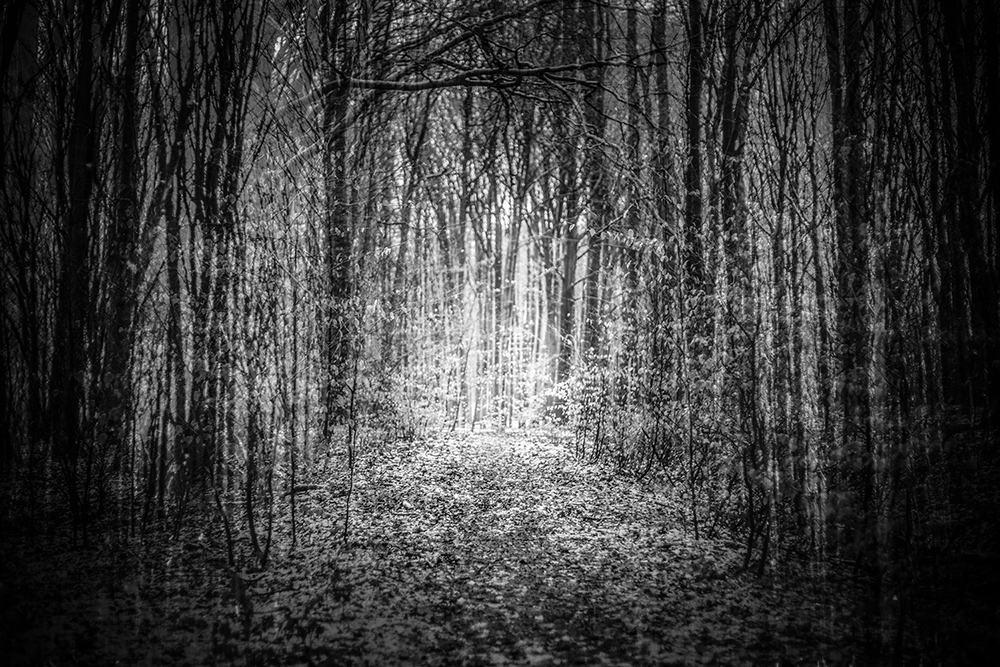
The illustration for this text is from the SZELEST series.
And that is precisely the point. Human beings are creative beings, beings who are constantly creating. It is a process that shapes our development and our ability to process what lies within us. It helps us to communicate, and sometimes it is even the only possible way to express our emotions and form connections.
And it doesn’t matter whether someone is knitting, painting or dancing. What counts is the expression.
Will AI give me all this? No, it won’t. Because I’m not interested in having an image or text ready straight away. I’m interested in creating it, step by step. So it’s about the journey, not just the destination.
There is one more thing that is essential in creation – movement. I set my body in motion, I interact with a place, with a person, I form relationships. The more time I spend at the computer, the more I appreciate this. The human body was built for movement, not for life without it.
And to answer the question posed at the beginning of this text:
there are undoubtedly areas of photography where a person with a camera will no longer be needed. This has already happened in the past – for example, large furniture companies have replaced interior photographers with 3D renderings. If I’m not mistaken, IKEA is one such example.
But where it comes to experience, conversation, attention, feeling and being present – a photographer will still be needed.
I look at the digital age and observe more and more initiatives aimed at returning to being together in person, in the real world. Humans are still social, relational creatures who need other people to regulate their emotions.
I also see this natural need for equilibrium and balance in the context of the virtual world. The more algorithms dictate what we should watch and listen to, the more artificiality there is in images pretending to be reality, and the more isolation results from sitting in front of a screen, the more activities there are aimed at integration, genuine connection, shared action and shared experiences.
The creative process can be difficult, demanding and time-consuming. But it brings a sense of fulfilment, satisfaction and pleasure; it allows us to express our individuality and can give meaning to life. It is an important part of being human.
The world of photography is changing once again, and it demands that photographers keep pace with these changes. And perhaps, paradoxically, more than ever before, I perceive photography first and foremost as looking and seeing, feeling and experiencing; I am increasingly less interested in mass appeal, speed and artificiality. And if this means I remain in a niche, I intend to make myself at home there.